register_link

Blog Archives

How do consumers listen to music?

What you'll learn in this post:
  • How long consumers listen to music and via which formats
  • How many consume livestreaming, radio, and even physical audio formats
  • Why the streaming boom has not eliminated piracy entirely

A study commissioned by IFPI surveyed 43,000 people in 21 countries on how they consume music. “Engaging with Music”, according to their own reports, is worldwide the biggest music-oriented consumer study to date. The biggest conclusion to draw from it is that consumers listen to an average of 18.4 hours of music per week. In the last study, conducted in 2019, it was only 18 hours. Assuming that the average song is 3 minutes long, this number is equivalent to 368 songs per week.

But where is this music played? Weekly music consumption is divided as follows:

FormatWorldwide
Premium streaming23%
Free streaming9%
Video streaming (e.g., YouTube, DailyMotion)22%
Short-form video apps (e.g., TikTok, Triller)11%
Social media platforms (e.g., Facebook, Instagram)3%
Radio16%
Purchased music (downloads, CDs, vinyl)9%
Live (including livestreaming)2%
Other5%

Streaming

A total of 78% of respondents said that they use streaming services. Out of those that choose to do without streaming, 35% said that they don’t need streaming services because they can find all the music they need on free video platforms.

The survey also shows that listeners don’t just consume whatever the algorithm sets in front of them.

  • 68% reported looking for a specific song more than once per week (16-24-year-olds: 82%)
  • 62% reported looking for a specific artist more than once per week (16-24-year-olds: 73%)
  • 62% reported listening to a self-compiled playlist more than once per week 16-24-year-olds: 78%)

Livestreaming / radio

29% of survey participants said that they watched a livestream concert. 65% will continue to consume livestreams even when live concerts are back. 55% view livestreams as a good alternative for when they are unable to attend a concert.

As the analysis shows, radio remains a medium that should not be underestimated. 74% said that they turn on their radio mainly for the music and 66% stated that they would not listen to radio if it weren’t for the music. In the 35-64 age range, 81% listen to the radio, among 25-34-year-olds, the number is still as high as 76%, and even when it comes to 16-24-year-olds, radio can count on two thirds of the demographic to listen in.

Physical audio formats

The study additionally shows that physical products have not entirely disappeared. 12% of respondents have purchased a CD in the last month and 8% have bought a vinyl. For both formats, 25-34-year-olds rank above average with 15% purchasing CDs and 11% vinyl. Vinyl consumers are particularly passionate music fans. 81% of them use streaming services and 67% reported discovering new music or new artists every week. They also listen to 22.1 hours of music per week on average, which is 20% more than the average respondent.

Stream ripping

But of course, it’s not all sunshine and rainbows. 30% of survey participants admitted to consuming music illegally. This is especially common among 16-24-year-olds, where the number reaches 38%. The most popular practice is stream ripping, which is used by 27% of respondents and 35% of 16-24-year-olds. This, unfortunately, shows that the streaming boom has not yet fully eradicated piracy.

Fun and joy

No matter how the music is consumed, almost everyone agrees that music is simply good for the mind. 80% of survey participants stated that music helped their mental health during the pandemic. Among 16-19-year-olds it is 85%. 87% actually said that music gave them fun and joy during COVID. Let’s hope that this joy leads to more streaming subscriptions, merch purchases, and concert viewership.

Pitch your songs to Amazon Music

What you'll learn in this post:
  • How to pitch your songs to Amazon
  • What guidelines must be followed
  • What other advantages the New Release Pitch Tool offers

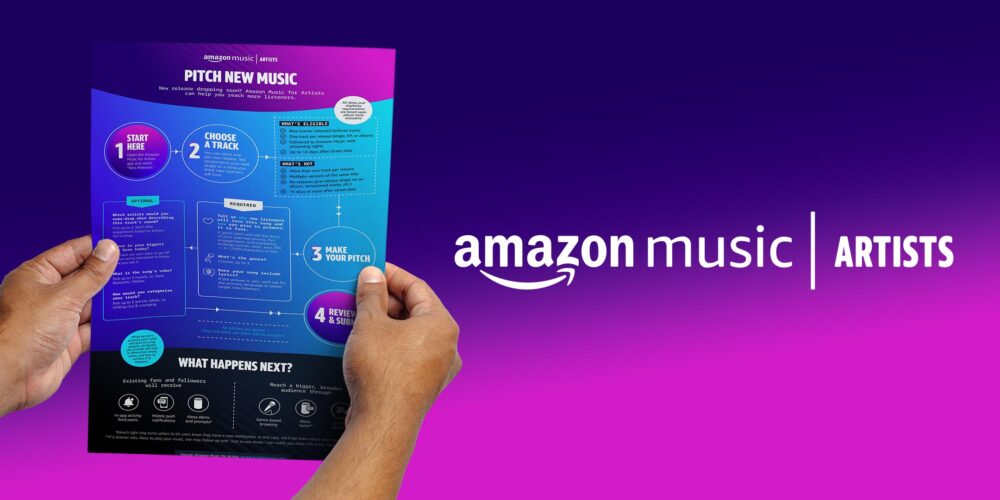
Up until recently, Spotify was the only place where artists, managements, and smaller record labels could pitch their songs directly to the playlist curators. Other streaming providers give this privilege only to the big labels and distributors. Now, Amazon Music has launched the tool “New Release Pitch” with which you can suggest your tracks for their official playlists and stations.

You can do this on Amazon Music for Artists, which is available both on the desktop site as well as the mobile app. These guidelines should be observed when pitching your song:

  • You can only pitch new, unpublished music (no re-releases)
  • You can only pitch one track per release, regardless if it’s a single, an EP, or an album
  • The song can only be submitted a maximum of 14 days after the release

This is how the New Release Pitch Tool works

Just like on Spotify, you will need to include a description of the song and a brief overview of the marketing activities you have planned. Additionally, you must specify the genre (up to 3) and language of the song, as well as whether it has lyrics or is an instrumental piece. You also have the option to add the vibe of the track as well as so-called “activity labels” (e.g., “chilling out”) if you so desire. Other optional details include the mention of up to three artists who make similar music and the location of your biggest fanbase, although Amazon admits that they obviously have this information already and that they are simply interested in your own assessment here.

More than just playlist placements

By sending Amazon your song along with the metadata, you not only get the chance to be considered for playlists or stations but also help Amazon work out how they should show your music to your listeners.

What this means in practice is posts in the activity feed, push notifications, and Alexa alerts for established fans and followers. However, you can also reach new listeners through searches by genre as well as suggestions from Alexa. That means that even if you don’t get selected by the curators, you will still enjoy certain benefits from your pitch and can increase your reach.

So, if you ‘ve never used Amazon Music for Artists before, you have one more reason to start now.at nun einen triftigen Grund mehr.

Amazon Music is also part of iGroove’s pitching services, along with Spotify, Apple Music, Deezer, YouTube Music, and Tidal.

Spotify integrates Shopify

What you'll learn in this post:
  • Spotify cooperates with e-commerce company Shopify
  • This will enable more artists to offer their merchandise directly through Spotify.
  • How to integrate your Shopify store with Spotify

Spotify has long planned to give musicians the option of selling merch through their platform, but so far, it has been a rather bumpy road. Towards the end of 2013, they started a collaboration with Topspin, but when Topspin was bought out by Beats Music which was then acquired by Apple, Spotify switched over to BandPage. However, here, too, a competitor interfered: YouTube took over BandPage, and thus, Spotify had to switch again, namely to their current partner Merchbar.

Merchbar, however, poses some obstacles for many artists, especially those who operate independently, which might explain why out of the million artists on Spotify, only 370,000 offer merch or tickets there. This is all to change thanks to the partnership with the e-commerce company Shopify – a collaboration waiting to happen based on the name alone, if nothing else. From now on, musicians can show three items from their Shopify store on their Spotify profile.

This is how it works

To offer merchandise from Shopify, you need admin access to Spotify for Artists, as well as a Shopify store. You can then import up to 250 items to your Spotify for Artists, out of which, as we mentioned before, you can pick three to show on your Spotify profile. So, you always have the option to customize the products that are displayed.

You will also continue to be able to offer items from Merchbar on Spotify. For that, however, you will need to disconnect the Shopify integration.

Only in beta

The integration of Shopify is still in beta, which means that while musicians worldwide can integrate their Shopify store, the products will only be shown to consumers in the USA, UK, Australia, New Zealand, and Canada. At the moment, Spotify is not charging any fees, but this will change in the future. But when that will happen and how much the cost will be is not yet known.

Try free of charge

In times where concerts are still a scarce commodity, it is certainly well worth it to set up a digital merch table in addition to a physical one. For a time, this comes at no additional cost either, since artists who have not yet used Shopify can try it for free for 90 days.

The gaming industry is growing more and more important for musicians

What you'll learn in this post:
  • How the music and gaming industries have worked together so far
  • Which symbioses are possible in the future
  • How musicians can increase their revenue through this

Gaming as a market leader

The days when video games were a niche topic are long gone. On the contrary: Now, the gaming industry is bigger than the music and the film business put together. Film adaptations of video games are no longer a novelty. But the music industry, too, is witnessing the enormous influence of the gaming world. This has now gone way beyond soundtracks or trailers with popular songs in them. In this post, we will talk about what the future holds, how far the symbiosis between gaming and music is going at the moment, and why rap music is playing a big role in particular.

New discoveries

According to MRC Data, 28% of Gen-Z music consumers discover new music through video games. These games are thus becoming an increasingly important medium for musicians not only through lucrative deals, but also as an extremely relevant promotional tool. Record labels are therefore striving for a good relationship with gaming publishers. That can far transcend the simple inclusion of a song in a game’s soundtrack.

Collaborations

The most prominent example for such a mammoth collaboration are probably the Fortnite live events. As part of the so-called Rift Tour, there have been interactive concerts with Travis Scott, Ariana Grande, and J Balvin. Way back in the day, placements in games like GTA, Tony Hawk’s or Guitar Hero were already able to give popular songs an enormous boost. In recent years, Eminem’s “Survival” was used for the trailer for “Call of Duty: Ghosts” and had a corresponding music video to go with it. The single went platinum in the US.

Monetization

While the music industry has almost entirely switched over to streaming in the past years, so-called free-to-play models have long been established in the gaming world. Loot boxes, battle passes, and other in-game purchases are a significantly longer lasting monetization model than a one-time purchasing price. The music industry is, therefore, also moving more and more in this direction – even Twitch, a platform originally created for gaming, is now being used by countless musicians. The readiness of fans to support and pay their favorite artists is growing. According to YouGov, 43% of Americans are willing to pay for a concert livestream.

The role of hip hop

Rap artists are some of the smartest and most progressive marketers in the industry. No other genre is so in step with and has such an influence on the zeitgeist as rap. This is not even necessarily due to the culture but more so the fanbase that is young, hungry, and ready for progress. Studies by Midia Research have shown that hip hop fans are especially indulgent in their passion, happy to spend money on merch, streams, and also in-game purchases, for example during the Fortnite concert events. In the future of these new business models, this could play an increasingly important role.

The future

What developments are coming in the future are hardly foreseeable. Some companies, including virtual reality market leader Facebook, are working on a so-called metaverse, for instance – an entirely digital hub world where users can practically do anything they want. The implementation of music offers unlimited opportunities in this area. This could open the door even to smaller artists, since so far, the video games, usually multi-million dollar productions, have only focused on already popular and well-established acts. New technologies like NFTs are already offering a small taste of the different possibilities and could play a big role in the metaverse.

Conclusion

The future might be uncertain but it’s certainly exciting. The music and gaming industries are entering into increasingly closer partnerships, new technologies are opening the doors for innovative ways of consumption and monetization models. Young fans in particular are ready to take this step forward. That should not only prove interesting culturally but also rather lucrative for both industries. What some of the drawbacks might be remains to be seen over the next few years.

Record label, distributor, and all that jazz – What you need to know about contracts

What you'll learn in this post:
  • What the differences are between deals at labels and distributors
  • Why this is mainly related to the master rights
  • What the contracts include and what the so-called options are

Why a deal at all?

Finally, a record deal – that seems to be the big dream for most newcomers. But is a record label really that important? Would a distribution deal, like iGroove offers, for instance, or even a non-binding distribution platform also do the job? Let’s take a look at the most important criteria for your decision and especially at which contract details you should pay special attention to. Where you sign or whether you sign at all is ultimately your personal decision that really depends on your situation and goals – there is no universal right or wrong here.

Record label or distributor?

What is even the difference between a record label and a distributor? For a cut of around 20%, a distributor will mainly take care of delivering your music to the stores and services, cutting down processing times, backing your playlist pitches, and providing you with statistics and support. The services of a record label go a little further: They essentially acquire the rights to your music, and handle marketing, planning, and many other tasks depending on the deal. Because of that, however, record labels also keep the lion’s share of the revenues – often 70% or more.

Want to keep your master rights?

While record labels usually acquire the master rights to your music, distributors will only take their share. Giving away the rights means that the music doesn’t effectively belong to you anymore. You still own the copyright (in the EU this can’t be given away at all), but the songs belong to the record label for the agreed amount of time or even forever. This does mean that the record label has a vested interest in making the music successful, but in a distribution deal, on the other hand, you retain all the rights and only pay the previously mentioned share of the revenues to pay for the distributor’s work.

Scope and timeframe

Most contracts contain a contract period as well as a number of songs that the signing has to deliver within a set timeframe. Major record labels additionally offer so-called 360-degree deals, where not only the rights to the recordings are transferred but also the live performance, merch, and publishing rights. While this makes a lot of things easier, it also creates enormous dependency. Many contracts furthermore provide the option that your contractual partner can have you commit yourself to them for a pre-determined number of additional songs.

Advance payment – who’s paying what?

A hefty advance seems, just like the deal itself, to be one of the top goals for aspiring musicians. But an advance is no gift; it needs to be brought in at some point. Should your revenues not meet the expectations, you won’t be able to make money off your music for a long time. Additionally, the question arises: What are you using the advance for? Who is paying for the production and videos? Who is paying for the marketing and how big is the budget? All these costs could fall to the artist or to the record label, depending on the contract.

Indies

Next to the big players, independent record labels are also an option: While the major labels have their own distribution structures, an indie label will take the master rights they acquired from you to a distributor and close a personalized distribution contract with them. While indie budget is usually significantly smaller than a major label’s, you won’t just be one of many signed artists there. As an alternative to the classic distribution model, there are also various digital aggregators where instead of giving them a share of your revenues, you simply pay a flat rate per year or per release.

Conclusion

Developing your own model has never been easier. Whether you want to make use of services offered by record labels should definitely depend on what you and your team can do yourself and what areas you need assistance in. Big artists often launch their own record label – but these are almost always joint ventures with major record labels. While contracts have become more complex, considering that every segment is drawn up individually and every structure can be set according to your specific needs, this also means that the options are almost limitless.

Spotify wants to take stronger action against artificial streams

What you'll learn in this post:
  • How Spotify wants to protect artists with legitimate streams
  • What the consequences are when you manipulate streams
  • How iGroove handles suspected fraud

As we have pointed out on multiple occasions, using artificial streams not only hurts all the artists who abstain from fraud – they often also hurt yourself. We have also questioned whether Spotify and other DSPs are consistent enough in cracking down on bot streams and other fraudulent practices. Spotify has now at least communicated that they will tighten the screw once more.

Despite numerous warnings from the industry, many artists are still responding to offers that promise a quick boost in streaming numbers. Spotify makes it clear: “We have a huge team of engineers working on detecting, mitigating, and removing artificial streaming activity across Spotify, so we can protect artists and their legitimate streams.”

When Spotify spots an artificial stream, it might lead to payments being withheld, streaming numbers corrected, chart positions adjusted, or even the music being removed from Spotify entirely. If the music is removed, the distributor will be notified and the artist will have the chance to prove that the streams were obtained through legal means, although few have been successful.

Spotify also points out in their video that you should keep an eye on your numbers on Spotify for Artists when you’ve booked a promotion. You can learn more about how to spot fake streams in this detailed article.

iGroove monitors the streaming numbers of their artists daily and sends out a warning as soon as the numbers start to look suspicious, so that the promotion can be aborted early.

Since Spotify can sometimes be very rigorous in their rule enforcement, correcting streams and removing music without prior warning, another problem arises: Someone could potentially buy artificial streams for another artist to intentionally hurt their career. What Spotify and other DSPs will do in such cases is still unclear.

TikTok takes over Europe

What you'll learn in this post:
  • TikTok cracks the 1 billion monthly users mark
  • This is not least due to the enormous growth in Europe
  • How TikTok could revolutionize online shopping

How’s it going at TikTok?

TikTok is now considered the most relevant promotional platform for musicians worldwide. The rapid consumability of content, the precise algorithm, and the countless tools and functions offer the chance to have enormous reach even without a huge fanbase. This is paying off: TikTok is experiencing massive growth! New features are added regularly and the numbers speak for themselves.

One billion monthly users

In July, TikTok reached a milestone: One billion monthly users worldwide. This point was crossed far quicker than competitors like Instagram ever did. The accomplishment can be credited largely to the rapid growth over the past year. As part of a legal battle with the US government, it was reported in July 2020 that there were 689,174,209 monthly active users at the time. That means that in one year, the platform grew by a whopping 45%.

More watch time than YouTube

But it’s not just about the users. One of the most important KPIs of any video platform is the usage time – and here, TikTok really kicks off. In this area, the app owned by the Chinese multinational corporation ByteDance has now overtaken even veteran top-dog YouTube.
The average TikTok user consumes more than 24 hours of content per month on the platform. On YouTube, it is only 22 hours and 40 minutes. Of course, with YouTube’s over 2 billion monthly users, its total cumulated watch time is still significantly higher – but there is certainly a clear trend emerging here.

The European market

TikTok is currently investing massive sums into the European market in particular. But it seems to be paying off: In 2020, the profit generated in Europe grew by an extraordinary 545% compared to the previous year – from around 22.9 million euros in 2019 to no less than 147.79 million euros. On the other hand, there were also exorbitant expenses: The costs in 2020 amounted to 557.55 million euros – 442% more than in 2019. This is not least due to the fact that TikTok hired more than 1,000 employers to work in Europe.

Shopping on TikTok

TikTok is aggressively investing in its own future. But to ensure that the profit will one day exceed the cost, they not only want to generate more users but also tap into more monetization options. For that, TikTok is collaborating with e-commerce platform Shopify. In the US, Canada, and the UK this shopping feature has already been rolled out. There, users can browse the app for the product catalogs of Shopify sellers and instantly acquire specific products that they have just seen in a video clip.

What’s next for TikTok?

TikTok is rapidly growing and continually expanding its features, and now, with its integration of Shopify, they might just revolutionize the online shopping industry and generate gigantic revenues. The enormous losses that TikTok reports are not uncommon in the expansion phase of a company of this size and point towards an even more accelerated growth in the future. After all, these are targeted investments. There are still numerous markets for TikTok to enter, in any case – but for now, the focus seems to lie on Europe.

News from the world of Spotify playlists

What you'll learn in this post:
  • What the new Enhance and Blend features offer
  • Spotify opens the Release Radar for advertising
  • Why there's trouble in playlist paradise

Playlists are one of the most important features of the platform for artists, consumers and Spotify itself. Accordingly, Spotify wants to continuously optimize them and add new options. We have summarized some of the latest developments for you.

Enhance

Anyone who creates playlists themselves is certainly already familiar with the recommendations on the part of Spotify, which are listed at the end of the playlist. They have now expanded this feature with the “Enhance” button, which is visible at the top of every playlist you create. Clicking the button, Spotify automatically adds songs to the playlist that they think will fit. Suggested songs are added after every two tracks, with a maximum of 30 per playlist. You can definitely add them to the playlist with the +, and of course the feature can easily be turned off again so that the playlist is as it was before.

Spotify Blend

Blend creates a playlist based on the music tastes of two listeners. The user has to invite a friend and Spotify will create a mix based on the listening habits of both people. In addition, a score is created that shows how similar the music tastes of the two are. You can also see which song was added to the playlist based on whose taste.

This is also a nice gimmick for artists and works well for casual social media content. For example, band members can compare their musical tastes, you can create a blend with artist friends or the band you’ll be performing with soon or of course give fans the opportunity to compare their musical tastes with yours.

Release Radar

The Release Radar celebrates its fifth birthday this year and looks back on 16 billion streams generated by it. This makes it one of the three most popular personalized playlists. The Release Radar is now the third personalized playlist (after Discover Weekly and On Repeat) that Spotify is opening up to sponsored content from companies. However, only consumers who use Spotify Free will hear the ads.

However, there is also trouble in the playlist paradise. TechCrunch reported on various curators whose playlists were removed for misuse. Users have the option to report playlists for sexist, violent, fraudulent or hateful content. Of course, this is absolutely right and important, but the problem is: as soon as such a report is received, Spotify removes the playlist’s metadata such as title, description or cover image without further review. Spotify vows to improve, which is also urgently needed, because otherwise it’s far too easy to blacken a rival.

What can musicians learn from the pandemic?

What you'll learn in this post:

The pandemic has been with us for almost two years now. For musicians, this means in most cases lower income, often an increasing psychological burden and often the feeling that the appreciation for their (own) art is not as great as they might have hoped. Some will also have lost faith in support from politicians. But what else do people take away from this exceptional situation – at best, even positive things?

Relying on streaming is not enough

Very few artists can live on their streaming income alone. While this is not a new insight, this fact was easier to ignore before the pandemic.

Only one source of income is not enough

Relying on one revenue stream as a musician can go well for a long time, but then it can suddenly come back to bite you in the ass. If you relied entirely on concert revenue, you were left high and dry during the pandemic. As an artist, you should always build up several pillars so that your income does not completely collapse when one of them disappears.

Be open to new things

Multiple pillars means openness to new technologies and revenue streams. Livestreaming can be an alternative or at least a supplement to concerts, you should at least read up on NFTs, there are more and more alternatives in crowdfunding, or maybe you can supplement your income by letting your music go viral on TikTok or by using it in videogames. Not everything suits everyone, but there are possibilities for everyone that you should not close your mind to.

Stay flexible and up to date

In order to be aware of these new developments, musicians, or at least their managers, should keep up with the changes in the music industry. It is also important to be flexible so that you can react quickly to developments. As with musical trends, it’s better to be there early than to try to jump on the bandwagon completely late.

Don’t just carry on as before

If the pandemic does eventually come to an end, don’t just pick up where you left off in 2019. Many new opportunities that arose during the pandemic will continue post-Corona. The world, as well as the music industry, is not the same as it was before, and this must be taken into account.

The musicians suffer – the industry grows

While many artists are going through hard times or even returning to their bread-and-butter jobs, many companies in the music industry are posting record sales and music start-ups are raking in millions. Put simply, the industry is doing great, while the musicians, without whom the industry would not exist, have been in crisis mode for two years. Similar to politics, everyone has to decide for themselves if they want to accept this or if they want to work for a change.

Spotify on the stock exchange – what are they doing there?

What you'll learn in this post:
  • Why the Spotify share is valued so high despite losses
  • For what reason Spotify buys back its own shares
  • Why musicians hardly profit from it

What is the situation like at Spotify?

Music streaming is a highly competitive business. Numerous providers are getting involved – even though the market is already bursting at the seams. The undisputed market leader is Spotify with 44% of the global market share in the first quarter of 2021. Apple Music is in second place with 18%. In the US as in many other countries, music streaming accounts for a good 80% of total revenues. So things are going pretty well for this now firmly established, but still quite young, growth market.

The IPO

This enormous growth potential has of course not escaped the investors. When the Spotify stock went public in 2018, it exceeded all expectations. The set reference price of $ 132 was three hours after the IPO at $ 165.90. Today, a share with fluctuations costs between 230 and 240 dollars. The then valuation of $ 23 billion stands today alongside a market capitalization of $ 43.21 billion.  Spotify is growing rapidly.

The balance sheets

However, these stock market valuations have little to do with economic reality. In fact, Spotify posted losses of EUR 20 million in the second quarter of 2021. In the company’s history, there were only five quarters in which the figures were in the black. Otherwise, Spotify’s balance sheets were always in deficit. Investors see the company’s future potential. Incidentally, it was similar with Netflix, whose profits are now constantly increasing.

The balance sheets

For the third quarter of this year, however, Spotify is planning large investments – in its own securities. The Swedish company plans to buy back its own shares worth one billion dollars. Spotify therefore continues to believe in its own growth and wants to profit from it as much as possible. Of course, the company’s own demand will also provide a positive impetus, which should cause the share price to rise further. Considering that the share had already touched the 350-dollar mark in the spring, the buyback should definitely pay off.

The investments

However, as economically sensible as this buyback may be in the long term, with a deficit balance sheet and so many open construction sites, the investment might have been more sensible elsewhere. The widely announced podcast offensive, for example, seems to be faltering – especially since non-exclusive podcasts on Spotify are still not monetized. Payments to artists are also much discussed. It is not just that other services pay significantly more generous revenues to musicians – the distribution model itself has also come under criticism.

The payout

There is no fixed equivalent for a stream at Spotify. Instead, the subscription income is distributed proportionally to their contribution to the entire streaming contingent. Big artists benefit enormously, while smaller artists only get the crumbs.

Is the stock market to blame?

It’s a common problem: the stock market distorts economic metrics. The price valuation of a company overshadows realistic valuations and balance sheets. Instead of hoping for small returns, a kind of game of chance is operated on the entire valuation, whereby the success of a company depends largely on its “reputation” among investors. This puts Spotify under enormous pressure – the entire strategy must be geared towards the share price.

What’s next?

Of course, going public also has advantages: the company’s liquidity is secured. Artists don’t have to worry about suddenly collapsing revenues, projects and collaborations can be financed and the platform expanded. If, however, little or nothing of this reaches artists and consumers, all the overwhelming reviews and successes will unfortunately bring nothing at all to those who ultimately should.

Catalog Migration: Switch to a New Distributor with a Few Simple Steps

What you'll learn in this post:
  • How to migrate a catalog from one distribution to another
  • What you need to pay attention to and how long it takes approximately
  • How iGroove minimizes manual effort and sources of error

We know the feeling all too well from insurance companies or mobile phone subscriptions: You realize that a different provider has a better offer in store and you could save a lot of money, but it’s just too much work, so you end up staying with your current provider. A lot of musicians and record labels go through the same experience when considering a switch from one distributor or record label to another. Many shy away from the manual effort and are unsure whether the streaming numbers and playlist placements would really be retained after a switch.

In this article, we will show you what to keep in mind when it comes to a catalog migration and introduce the elegant solution iGroove has recently developed.

Metadata

We have already pointed out on multiple occasions how important metadata are in the music industry and why they represent an artist’s calling card. Everything begins with metadata – and a catalog migration is no exception. They ensure that your releases are shown on the DSPs exactly as they were before the distributor change and that your fans don’t even notice the migration.

So, first, you need to compile all the metadata for the releases in your catalog. You can find these in your distributor’s system (with some luck, they might even have an export feature) or you can get them from your record label.

After exporting the metadata from your old distributor, you then need to manually register the metadata for each release with your new distributor.

Metadata includes:

  • Release and song names
  • Song length
  • Artist names/information about features, etc.
  • Composers, lyricists, etc.
  • EAN
  • ISCRs

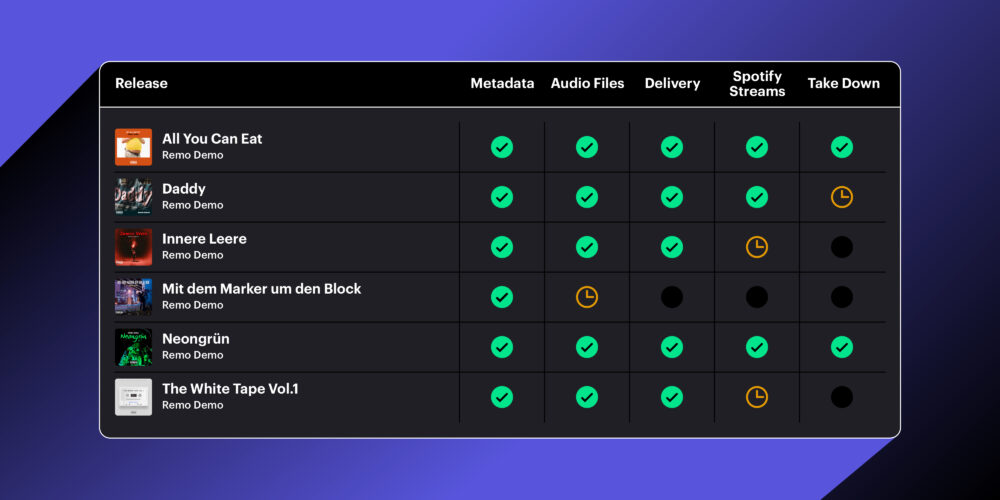
In addition, the WAV-files for each of your releases, of course, need to be uploaded again. Furthermore, in order to ensure that the releases end up on the right profiles, the Spotify and Apple Music artist IDs must be added, as well (provided your distributer offers this option). Only when all this information is stored on the database can your distributor transfer the releases to the different stores.

Delivery and takedown

Your new distributor might get in touch with the DSPs in advance to announce the migration of your catalog. Once you have gathered all your data, the distributor will forward them to the stores. About two or three days after that, they will check if all the releases were successfully and properly delivered. On Spotify, they also need to check whether the streaming numbers were transferred correctly. If this is not the case, your new distributor will contact Spotify and find out why.

Only when everything is checked and found to be in order, the takedown call is made to the old distributor. This means that for a short period of time, your releases will be show up twice on the platforms. But this only lasts about 2-3 days, provided that your old distributor immediately initiates the takedown. To make sure that your releases don’t appear twice for too long, it would be wise to get in touch with the previous distributor ahead of time to get information on the process and to announce the upcoming takedown.

If everything goes smoothly, a catalog migration should take about a week. But since a lot of different parties are involved (artists, new and old distributor, various stores), delays do occur sometimes.

iGroove’s solution

More and more artists are switching over to iGroove with their catalogs, and to keep the potential error sources, delays, and manual effort to a minimum for us, we have developed the catalog-migration engine. It is based on the following components:

Release importer

Instead having to laboriously gather the metadata one by one, the release importer will take over this task by automatically searching for all the important data in the different stores and directly importing them into your account. To do that, we only need you to submit a list with the EAN codes for your releases.

Once the release importer has compiled everything, all you need to do is upload the audio files and your releases will all be registered properly.

If your previous distributor is a major one, we also offer the option of directly importing all the data that was exported from there, including the WAV-files.

Metadata verification

If the data are delivered directly, our system will independently check whether all the listed metadata (e.g., composers, lyricists, info about explicit content, etc.) match the current data in the music stores. If it detects any discrepancies, a ticket is automatically created and will be handled by our team. If need be, they will confer with the client to get the differences corrected as quickly as possible.

The system also checks if the uploaded audio files have the same length as the songs currently available at the stores. The process is important for the retention of the streaming numbers, since this calls for identical audio files. If the system finds anything remiss here, we will ask the client if there might have been a mistake in the upload (e.g., two tracks got mixed up).

Compiling of artist IDs

Artist IDs guarantee that the releases (including future ones) end up on the correct artist profiles on Spotify and Apple Music. Since the process of searching and compiling all the IDs in a catalog can take up a lot of time, our system will take care of the job for our clients.

Transfer to music stores

Once all the metadata is compiled correctly and the audio files are uploaded, our system will transfer the releases to the selected music stores at hyperspeed and automatically check if they have arrived. To allow our musicians to always stay up-to-date, we have created a dashboard where you can follow the progress in real time. If an error occurs in the transfer (e. g., a connection problem), our system will automatically detect this, and the process will be restarted an hour later.

Review of streaming numbers

Before the transfer, our system saves the current Spotify streaming numbers for each song. Once the releases are transferred to Spotify, our system matches the numbers and verifies that they were carried over correctly. Artists can check the progress of this review in real time, as well, and see which releases have had their streaming numbers fully transferred. Thus, it is guaranteed that the streaming numbers carry over and the playlists placements are retained, as well.

Takedown verification

The dashboard shows the artist when a release is ready and the takedown can be requested from the old distributor. In addition, the system monitors whether this request was carried out, and most importantly, whether everything was really taken down. Sometimes, the old distributor might just take down 20 out of 23 songs, for instance. The system will detect this, as well. Thus, our users can always keep track of what releases can be taken down, which ones have already been taken down, and which ones are still pending.

iGroove Extra

As mentioned before, we save the Spotify streaming numbers for each individual song. This allows the artists to request the takedown of a release from their old distributor directly upon its transfer – without having to wait for the streaming numbers to be transferred over, as well. In case they are not automatically transferred, we can send Spotify a report with the saved data so that the numbers can swiftly be corrected. Thus, the duration of time in which the releases appear twice is minimized.

Conclusion

A catalog migration might not be a walk in the park, but if you keep a few points in mind, it doesn’t have to be a rock climb either. If you are convinced that you will get better terms and conditions from a different distributor, then the one-time manual effort is well worth it. If you decide to switch over to iGroove, most of the manual effort will be taken off your hands, many potential sources of error will be eliminated, and you will always remain up-to-date on the current status of your migration.

Are albums too long?

What you'll learn in this post:
  • Why albums are getting longer again in the streaming era
  • How much the consumption of albums declines
  • Why constant output is more important

Every now and again, the same discussion keeps coming up: Are albums still relevant in the streaming era or is the music industry today only concerned with singles and their placement in the playlists? What doesn’t get talked about as much, although it might very well be fueling this waning interest in albums, is the question “Are albums nowadays simply too long?” Do more songs really give fans added value or are they merely a clumsy attempt to increase profit?

Longer albums in the streaming era

If you’re a rap fan, it is likely that you recently had to push through Kanye’s and Drake’s albums (27 and 21 songs, respectively). These are only two examples of current albums that cross the 20-song mark. Overly long albums have obviously been around long before the streaming era. In the rap scene, especially, albums in the 90s often contained 20 or more songs (as well as a lot of interludes). At some point after the turn of the millennium, however, albums generally became shorter – after all, you earn the same amount of money from a CD no matter if it had 11 or 22 songs on it.

Streaming has flipped this trend on its head. On one side, artists no longer have to limit in their album length to fit the media of CDs or vinyl. On the other, more songs often also mean more streams. Whether more songs also mean better quality is a different question. The fact is: In many matters, less is more, but in the music industry, this principle doesn’t seem to apply and albums are becoming longer again.

Album consumption is declining

It goes without saying that this is paying off for artists like Kanye or Drake, whose last four albums contained 22 songs on average. But for artists without superstar status, it remains questionable if listeners really are willing to work through that many songs. One statistic says that 54% of music consumers are listening to fewer albums than they did five years ago. Young listeners, in particular, very rarely consume albums, and it is more than doubtful whether overly long albums heighten the enthusiasm for the format.

Constant output is key

So, if you’ve had a productive time in the studio and are sitting on 24 songs, for instance, you should first ask yourself whether all of them meet the standards of quality. Here, it is helpful to not only have yes-men around you but also people who can tell you honestly when it is best to just leave a song on the hard drive. However, even if you come to the conclusion that the world has just been waiting for each and every one of those 24 gems, it is debatable whether you should really put them out there all at once.

Instead of cramming 24 songs into one album, it is better to pick only the 10-14 best tracks that also have a common thread running through them. The rest can be released before or after the album either as singles or EPs. Thus, the public focus isn’t just on a single release, you will have more of a regular output, you can pitch and promote more songs, and you’ve got a coherent album out first. The age of streaming demands constant output and only few artists can afford to release a one-and-a-half-hour album without a preliminary single like Drake.

Another option is to release the album with a manageable number of tracks first and then to put out a deluxe version with additional songs a few weeks or months later. That way, your fans have the time to process the first portion of the songs and will be ready for a second helping of music later. In most cases, you’ll be better off regularly feeding your fans bitesize chunks instead of serving up an oversized platter.