register_link

Blog Archives

User-centric distribution model: A revolution in streaming revenue payment?

What you'll learn in this post:
  • The difference between the existing pro-rata model and the user-centric method
  • Why at pro-rata also Justin Bieber receives money from you, even if you have never heard him
  • What a study found about the benefits for independent artists

All relevant streaming services pay musicians based on the so-called pro-rata distribution model. To put it simply, all streams are thrown into one pot and the revenues distributed by percentage. Suppose there are a total of 1 million streams and 10,000 of them are yours, that means you receive 1% of the total revenues. What this method doesn’t take into account is the individual listening patterns of the individual users.

System change is demanded

More and more voices are being raised demanding a fairer “user-centric” distribution model. In the user-centric model, the revenues garnered by each user would only be distributed to those artists that they actually listened to. While in the pro-rata model the Justin Biebers of this world will receive a portion of someone’s subscription fees even if they’ve never listened to them, this model would only support those artists that they actually streamed.

So, suppose that from someone’s subscription fees, 10 euros are distributed to the artists. If this person only listened to 10 songs from 10 artists, then each one of them would receive one euro. In the pro-rata distribution model, on the other hand, those 10 euros would just be thrown into a big pot and end up in some random artist’s account.

Is SoundCloud switching to User Centric?

After Deezer announced some time ago that they might change their model and nothing happened, things could take a more definitive form at SoundCloud.

Since SoundCloud is less dependent on big labels than other streaming providers, it would be easier for them to take this step. Still, the challenge is not to be underestimated. Whether SoundCloud will really change their model or just introduce a feature which offers users the option to “tip” their favourite artists, remains to be seen in the first quarter.

Do artists benefit from the user-centric model?

One of the most frequent criticisms of the pro-rata distribution model is that it favours major labels. The user-centric model was devised to benefit independent artists in particular. It will certainly satisfy listeners more if they knew that the musicians that they actually listened to are also the ones being paid. But would artists really benefit from a system change? A French study has examined and compared the two models

The study shows that it would primarily be the top 10 most streamed artists who would have to deal with significant losses (17.2% on Deezer, 12.5% on Spotify). Percentage-wise, artists with the least number of streams will profit the most, although we are still talking about small amounts here. The share of paid royalties will only decrease for the top 10 artists.

Artist Rank (based on streams)Pro RataUser Centric
1-109.3%7.7.%
11-10021.6%21.8%
101-100036.4%37.2%
1001-1000025.0%25.1%
Over 100017.7%8.1%

In practice, this would mean a loss of several hundred thousand euros for the top 10 artists. The artists on ranks 11-100 would earn about an additional 9,000 each; those on ranks 101-1000 around 2,500 per artist. For everybody else it would only make a difference of less than 10 euros per year. A real profit would mainly be gained by most of the top 1000 artists, but for the large majority, the effect would be fractional.

Big losses for HipHop

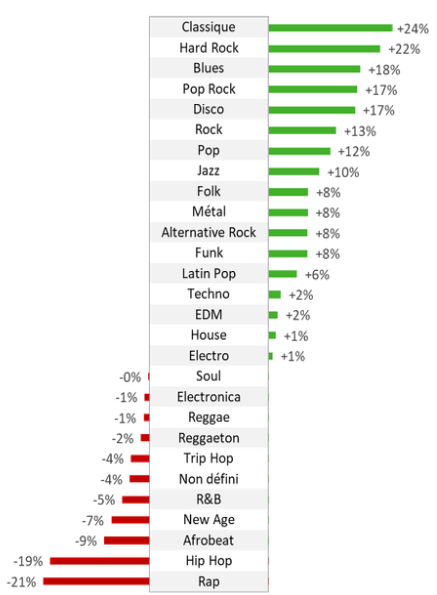
Another profiteer would be the back catalogues of artists, which would now receive 52.1% instead of 48.9% of the royalties. But the real big changes would happen between genres. This is because niche-genres would benefit the most from a system change, especially classical music, hard rock, and blues, but also popular genres such as pop and rock. This change would mainly occur at the expense of hip hop releases, which would lose a big fat 40% of their revenues.
Meanwhile, a shift from big corporations to smaller distributors cannot be observed. On the contrary, the five biggest companies would actually increase their market share by 0.7%.

However, the study did note advantages in the prevention of fraud by buying streams.

The study further observes that changing the distribution model has high cost implications. This is probably one of the reasons why barely any streaming provider has considered the change so far.

But at the very least the numbers from this study also show that a system change would have little impact for the lower-tier compensation of artists anyway. As soon as new data appears or new models are introduced, you will find out about it here.

The study by the Centre National de la Musique (CNM) is based on numbers from Spotify and Deezer, as well as various major and independent labels. Other streaming providers refused to provide their data for the study. The analysis uses numbers from 2019 and was conducted exclusively on French users with a premium subscription.
TikTok – trendsetter in the music industry

What you'll learn in this post:
  • TikTok's focus is more on music than other social media apps
  • How success on TikTok helps artists break through in other ways as well
  • Which genres are particularly popular on TikTok

Only dance videos and lip-sync? TikTok has long been one of the most important trendsetters in the music industry.

By 2020, most musicians should have realized that TikTok is much more than just dancing underage girls. There are few social media apps that focus as much on music as TikTok. With 800 million users, TikTok also has an enormous reach, and this reach will remain, since President Biden has also taken the blocking of the app in the U.S. off the table for the time being. TikTok will therefore remain one of the most important trendsetters in 2021.

The fact that TikTok can push songs into new spheres and launch careers is no longer a secret. Here are some concrete numbers on this:

  • 176 songs reached over one billion video views on TikTok in 2020
  • 90 songs that trended on TikTok reached the top 100 on the Billboard charts
  • Of those 90 tracks, 15 even reached #1
  • 70 artists received a major deal after their music trended on TikTok

Fans and A&R’s discover artists via TikTok

TikTok is without a doubt one of the most important places for young people to find new music. Likewise, numerous A&R’s use the platform to discover new talent. In addition, the majors (and other labels) invest large sums of money in advertising campaigns on TikTok, which further emphasizes the importance of the app.

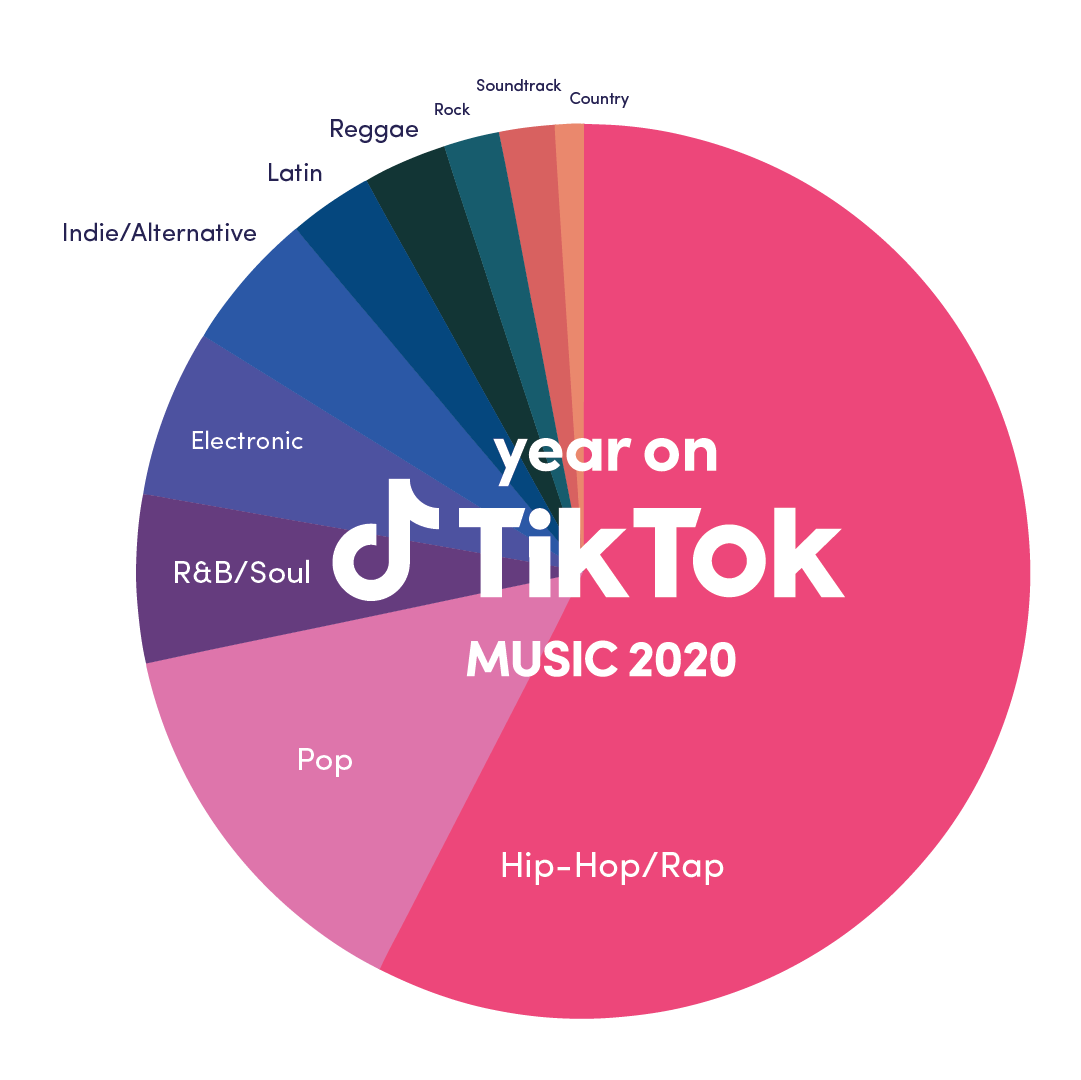
HipHop dominates on TikTok

So as an artist, there’s less and less of a way to avoid having a presence on TikTok. But does this apply to all genres?

The dominant genre continues to be hip-hop, and pop, R&B, and electronic music are also popular. However, this does not mean that for other genres TikTok is useless. With 800 million active users (100 million of them in Europe), you can always find your niche and even have the advantage of less competition.

More streams thanks to TikTok?

The crucial question is, of course, whether a large reach at TikTok automatically translates into increasing sales and more streams at Spotify and other streaming services. This is unfortunately very difficult to measure, but there are at least numerous success stories that strongly suggest it.

So it’s certainly helpful for artists to compare their TikTok insights to their streaming numbers to find out the effect of TikTok.

The fact is, TikTok is an unpredictable platform and it’s hard to predict which song will go viral and which will get lost in the crowd. Soon you can find out how to positively influence TikTok’s algorithm here at iGroove Magazine.

What are Art Tracks on YouTube?

What you'll learn in this post:
  • Art Tracks are an audio format on a video platform
  • Pros and cons of Art Tracks
  • Whether you also earn money with Art Tracks

What are Art Tracks exactly, why should I make my music available to everyone on YouTube, and will I make any profit from it? We have the answers right here.

YouTube’s Art Track feature is one many are unfamiliar with and is therefore often cause for confusion. We’ve put together an overview for you to try to shed some light on the subject.

What are Art Tracks?

A music video with a static image (album cover), the audio file, and the most important metadata. It’s YouTube’s way of ensuring that the audio formats work on a video platform, as well.

When you submit your music to YouTube via your distributor, not only will registered subscribers of YouTube Music be able to listen to your song, but thanks to the Art Tracks feature also people on the “normal” and free YouTube.

Each individual song will have an Art Track set up for it: so, in an album with 10 tracks, for example, you’ll find 10 Art Tracks on YouTube.

Mixed opinions about Art Tracks

Artists’ opinions differ in this regard: Some are well aware that YouTube is factually the biggest streaming service there is and they absolutely want to make their music available on it. Others, however, are not willing to essentially offer their music to anyone almost for free. That’s why iGroove gives you the option to decide for every release whether you only want to make it available on YouTube Music (Premium) or also as an Art Track (free).

Compared to user uploads, Art Tracks have the advantage of a better audio quality. Additionally, they increase the chances of users discovering more of your music through your Topic Channel.

Even better if you request an Official Artist Channel, because with it you can have all of your own uploads as well as all Art Tracks of your topic channel in one profile. You can find the other advantages that come with the OAC on our other post.

Do I get money from Art Tracks?

Yes, for each view you receive a portion of the revenues that YouTube gets from subscriptions and advertisements.

There is also the option to make your own Art Tracks and upload them. You can monetize these via your Content ID. But whether you will make enough of a profit that it justifies the extra effort is, at the very least, doubtful.

If you want to maximize revenues on all ends, you should make your music available both on YouTube Music and as an Art Track. Additionally, you should use YouTube’s monetization option so that you also make money when other people use your music in their videos.

Why you should always be in promotion mode

What you'll learn in this post:
  • Why you shouldn't just promote when a new release is coming out
  • How to gain new followers and turn them into real fans
  • What you should pay attention to with your promotion activities

A lot of artists are only in promotion mode when a release is coming up. But really, you should promote yourself and your music consistently and always remain active in between releases, as well. Even when you’re in the studio and working on new material, you should constantly keep in contact with your fans – because they are quick to forget.

There is always something you can promote

Even when there isn’t a release coming up, there is always something you can promote – whether it’s a new social media channel (e.g., you can now find me on Clubhouse, as well), a give-away, a new website, or a virtual concert. The main goal should always be to convert occasional listeners into long-term fans. It’s not enough for people to listen to your music every now and then. Hardly anyone can live off their streams or heaps of views on TikTok.

What you want to achieve is gain a lot of new followers and turn them into real fans who will check out your new releases.

Selling by storytelling

You don’t get there by constantly asking people to buy stuff from you. People want to be entertained by good music and creative content on your social media. Offer them a behind-the-scenes glimpse and let them be part of your musical journey, your studio sessions, etc.

Call to action

Even though you shouldn’t be too pushy, a call to action is always a must. The general attention span is short and with a call to action, you can lead people to where you want them to go.

Planning the release

A release takes planning and advance preparations. Before getting an album out there, it is imperative that you release and pitch multiple singles first and also make a couple music videos. That way you always have something new to promote.

Allocating the budget

As mentioned in one of our other posts, you should always have enough of your budget saved for promotion and not spend it all on production. At the beginning of a career, you have to invest more than you might get out of it.

Offer something special

In this pandemic, it has become clear that in most cases, streaming revenues are not enough. So, offer your fans something special like an awesome Deluxe Box, creative merchandise, a limited vinyl edition, etc.

Visuals

A lot of artists often neglect the visual aspect. A creative music video, cool photos and video content on social media, Canvas on Spotify, or an eye-catching Artwork increase the chances of people becoming interested in your music.

Newsletter

Social media posts only reach a fraction of your followers. Those who are really interested in your music will want to sign up for a newsletter, which is why it is one of the best tools for artists to advertise and sell their products.

You want to discuss your release and promotions plans? As an iGroove client, you can set up a call anytime with our promotion experts who will gladly set up an individual plan for you.

The risks of buying beats on the internet

What you'll learn in this post:
  • What it means when you don't buy the exclusive rights to a beat
  • What the advantages are of buying exclusive rights
  • Why leasing is still recommended for newcomers

If you’re buying beats on the internet, you not only have a wide selection to choose from but also access to good quality at a great price. But there are also some stumbling blocks in the way. Here, we’ve put together all the things you need to watch out for.

More and more artists look for the right beat for their songs on the internet. That way, you come in contact with producers that you would have never met otherwise and can secure quality beats without a hassle and often also at very affordable prices. But the devil is in the details, or rather, in the contract that you usually have to sign at the purchase. We will show you what you have to look out for.

Beat leasing limitations

If the beats are low priced, it is usually because you are not buying the exclusive rights, but are just leasing the beat. This means that one, the producer can still sell the beat to other artists, but also, that you are limited in your use of the beat. This could mean that you can’t release the song on streaming platforms or if you can, then only up to a certain number of streams/sales and for a limited time.

What’s almost always forbidden is the monetization of tracks via the YouTube content ID. The reason is simple: If multiple artists use the same beat, ownership conflicts will automatically arise.

Similar conflicts can come up when you make your song available on Facebook or Instagram. In both cases you should abstain from uploading if you don’t have the exclusive rights.

Advantages of buying exclusive rights

According to an article by Rolling Stone Magazine, there have been more and more instances where managers buy the exclusive rights to a beat as soon as a song goes viral. This doesn’t have to lead to problems right away, but when the license for the beat runs out, you will have to deal with a new negotiating partner and won’t be able to extend the license on the same terms and conditions. If it becomes apparent that your song is about to blow up, you should contact the producer ASAP and secure the exclusive rights.

Are the samples cleared?

If it’s not explicitly mentioned in the contract, you should always ask the producer whether the beat contains samples and if so, whether these have been cleared (which they most likely have not).

As already mentioned in our post on samples, in the worst-case scenario, you could get sued for using a beat with samples.

Leasing for the budget

Especially for artists who are still at the beginning of their career, it is advantageous to lease beats and keep costs low. The beat should never consume the whole budget; there should always be something left for the promotion.

In any case, you should read the contract closely, so that you know exactly what you can and cannot do with the song. If you’re absolutely certain of the quality of the song, it’s worth investing from the start and purchasing the exclusive rights.

Virtual concerts – they’ve come to stay

What you'll learn in this post:
  • Why virtual concerts will continue to exist even post-corona
  • What the advantages of virtual shows are
  • Why virtual concerts are comparable to live broadcasts of sports events

It’s becoming more and more apparent that virtual concerts are here to stay even after the pandemic. This post explains why that is and what advantages come with virtual shows as an addition to live concerts.

Many view virtual concerts only as a makeshift solution during the pandemic or ignore the topic altogether. But it has become increasingly apparent that this form of concert will continue to exist post-COVID, as well. Of course, they will never replace a live event, but there are good reasons why they will still be present as an addition.

Live industry revenues at rock bottom

The concert industry has essentially been brought to a screeching halt by the pandemic. Globally, revenues in the last year dropped by 75%. Virtual shows have become one of the ways in which to compensate for at least a part of the cancelled events. Based on one assessment, virtual concerts in 2020 have brought in $600 million already. This, despite the fact that up until now, only 9% of the potential audience have effectively watched a livestream.

A survey has shown that 80% of viewers were satisfied with the experience and that 74% were willing to pay for it. It’s become more and more clear that a new video format is emerging and taking root. We’re not talking about some dude anymore who plays guitar in his kitchen and streams it on Insta with mediocre sound quality, but instead professionally organized shows with ticketing and excellent sound quality.

The advantages of virtual concerts

Here are a few examples of why virtual concerts are still a worthwhile addition even when we can attend live concerts again:

  • Hybrid shows: If a concert is sold out, you can sell additional tickets for the stream
  • You can reach fans which are not in the area in which you’re playing
  • With a virtual concert you can reach fans who are too young for the live event, can’t afford a ticket, or can’t leave the house that night
  • As a promotional tool: A virtual concert can, for instance, give a little taste for the live tour
  • The concert market is competitive: With virtual shows you can prove to bookers that you put up good concerts and can attract people

Virtual concerts are well on their way of becoming a part of the relationship between artist and fan. You can build a different type of connection than you can at live concerts by responding to questions from fans, for instance, or even letting them decide on a setlist.

Virtual concerts as a addition to live shows

One day virtual concerts might be comparable to live broadcasts of sporting events. Of course, it’s more fun to watch in the stadium, but you probably won’t travel to every single away game, and even when it comes to a home match, you might sometimes prefer to watch from your homely sofa instead.

The combination between live and virtual concerts allows artists to perform more regularly and to give fans more options – with regard to pricing, as well.

A first few festivals have already announced that they won’t be taking place in 2021 either. The renowned Montreux Jazz Festival recently announced that in future, too, they will opt for a hybrid model consisting of both live events and digital projects.

Every artist who so far has generated a part of their income through live shows should by now be thinking about ways to reach their fans virtually, as well.

How to set up virtual concerts and make money with them, you will learn in this post.

Streaming – the gravedigger of the music industry?

What you'll learn in this post:
  • How strongly streaming dominates the music market
  • Why streaming is not generating all-time high revenues, even if people like to claim so
  • Whether artists benefit from the streaming boom

Did streaming save the music industry from going under, or are streaming providers much more the gravediggers of the music industry? We took a look at the numbers.

There have been discussions about the level of payouts ever since streaming became established. With the pandemic and the resulting loss of income sources, streaming providers faced even more criticism. Is streaming the salvation for the long struggling music industry or much more its gravedigger? We will be addressing this topic several times in the coming weeks and months.

The fact is that revenues from CD sales and downloads are collapsing, and only vinyl remains stable at a low level or is even growing. Streaming dominates the music market: In the USA, 85% of revenues come from streams, in Germany it is already two thirds. Does this mean that the music industry has defeated piracy and is generating record revenues?

Higher revenue thanks to streaming?

No, in 2019 (no more recent figures available yet), the music industry generated $20.2 billion worldwide. In fact, this is the highest revenue since 2004 when revenue was $20.3 billion. However, in the years before, the revenue was much higher namely at 21.9 billion (2002) or even 23.4 billion (2001) thanks to CD sales that were still flourishing at that time.

However, if inflation is taken into account, things look different again: In 2007, when Spotify was launched in Europe, the music industry generated 18 billion. Adjusted for inflation, the figure is 22.19 billion, which is significantly more than the sales in 2019. The launch of Spotify and other streaming providers has therefore not ensured a flight to new heights, but only slowed a steady downward trend.

Do the artists benefit?

The crucial question, however, is whether more artists are benefiting now than when major labels and CD sales dominated virtually everything. Take Spotify as an example: in 2020, 90% of all streams, and therefore about 90% of revenues, were generated by 43,000 artists. According to Rolling Stone magazine’s calculations, this equates to about $100,000 per artist on average. Compared to the previous year, 43% or 13,000 more artists are among the top earners.

If growth remains constant, by 2023, 100,000 artists will be able to live off their Spotify payouts alone. Even though it will still only be a small elite that can make a living from Spotify streams, this is a satisfying development. Even in the CD era, it was only a fraction of artists who got a really big piece of the pie.

Conclusion

It is therefore too easy to demonize streaming services across the board. However, neither are they the saviors of the entire music industry. As mentioned, we will explore this topic further and also reflect on what changes it would take for significantly more artists to be able to live off their streaming revenues.

Clubhouse – Hype or Revolution?

What you'll learn in this post:
  • For newbies: what Clubhouse actually is
  • What the advantages of the social audio app are
  • Whether you can earn money as a musician with Clubhouse

Is Clubhouse just short-term hype fueled by the pandemic, or really the biggest social media revolution since TikTok or Instagram?

Assuming you don’t live under a rock, you’ve almost certainly heard of the app Clubhouse in recent weeks. Invitations are in high demand, more and more celebrities are using the app, and despite manageable user numbers, it’s already worth billions. Even though everyone is jumping on it at the moment, the question remains whether Clubhouse can establish itself or whether the hype will quickly cool down again. We asked around.

What is Clubhouse?

Compared to other social media apps, Clubhouse does without text and image posts. It’s all about the spoken word. Users meet in rooms and discuss specific topics (or just listen). The makers are focusing on scarcity; so far you can only join with an invitation plus Clubhouse is only available for the iPhone. According to the latest figures, the app has 2 million active users per week.

What are the advantages?

A lot of interesting people are on Clubhouse, so you can get a lot of expert knowledge.

Networking: it’s easier to talk to people who would otherwise be difficult to get in touch with.

Contact with fans: Clubhouse offers two-way communication with your fans. Fans can ask questions and there is a direct exchange.

The fact that not many users are using the app yet is of course a disadvantage from the musician’s point of view. However, it can be an advantage that Clubhouse is not yet so crowded and you can build a network more easily as an early adopter.

If you join a discussion, your followers will receive a notification. If they join, their followers are notified, and so on. So it’s worth starting a discussion with other artists to reach out to multiple fan groups.

Earn money with Clubhouse?

Clubhouse is already planning to pay creators. Under discussion are tips or even that you have to buy a ticket to participate in a discussion. Of course, this will only be really interesting if the app can establish itself in the long term and greatly increase its user numbers. But will Clubhouse have an effect like no social media app since TikTok or Instagram, as certain experts are already predicting?

One thing is certain: Clubhouse has the attention and the financial resources. In addition, more and more celebrities and opinion leaders are using the app, and even big companies are jumping on the train. But it is also agreed that Clubhouse would never have been the talk of the town so quickly without the pandemic. We are now eagerly awaiting the launch of Clubhouse’s new features and whether they will make the app even more interesting for musicians.

Jesse Kirshbaum of Nue Agency has come up with an interesting thesis. She believes Clubhouse will revolutionize the podcast world. Right now, it’s frowned upon to record your conversations on Clubhouse. However, she believes that will change soon and thus there will be plenty of material to satisfy the hunger of Spotify, Apple Music, Amazon, etc. for new podcasts. It remains exciting and it certainly can’t hurt to grab an invite.

How many streams do I need to be able to live off them?

What you'll learn in this post:
  • How many streams it takes to get the minimum wage in the US and UK
  • Why UK artists need more streams
  • In both countries you need 3 million streams or more per year

How many streams do I need per month to be able to live off them? Based on the minimum wages in the US and UK, we’ve calculated the answer for you.

iGroove’s goal is to help artists make a living off their art. Since downloads and physical sales are steadily on the decline and concerts are at the moment still a thing of the future, we have calculated how many streams you need per month to be able to live off them. As a reference we’re using, quite modestly, the minimum wage in the US and UK.

Additionally, we are assuming that most streams are generated in the artist’s home country. The calculations are based on the analysis of the payments made by Spotify and Apple Music.

Based on the data from our artists, we assume 90% of streams in the UK to come from Spotify and 10% from Apple Music, while in the US 65% of streams come from Spotify and 35% from Apple Music. We further assume that the artist is releasing their music independently and they therefore don’t have to give up a big portion of the revenues to a label.

US

We are basing these calculations on a minimum wage of $7.25, which at 40 hours a week amounts to $15,000 per year and $1,250 per month. Additionally, we counted around $3,526 of revenues per 1 million streams on Spotify and $7,640 on Apple Music.

So, you will need around 170,000 streams on Spotify and 85,000 streams on Apple Music to reach a minimum wage income. For a whole year, this number will come out to around 3.06 million streams on both platform that you will need to be able to make a living.

UK

In the UK, we are working with a minimum wage of £8.72 per hour, which at 40 hours a week amounts to around £18,317 per year and £1,511 per month. The payment per one million streams amounts to £3,544 on Spotify and £8,308 on Apple Music.

So, a UK artist has to reach 338,000 streams per month on Spotify and 37,555 on Apple Music to reach a minimum wage income. Per year, this would mean 4.5 million streams on both platform.

A UK artist therefore needs a lot more streams to reach the minimum wage.

This is partly due to the fact that the minimum wage in the UK is higher than in the US. Another reason is that in the US there is a significantly higher portion Apple Music streams, which pay more.

Forecast your future revenues

Do you want more planning reliability and know how much you will earn in the future? With our AI “Muse” we can calculate your projected streaming revenues for the next 6, 12, or even 24 months.

These numbers will help you decide whether you can live off your music. Of course, you shouldn’t necessarily aim for just minimum wage; we only used it for the purpose of comparison.

More information

Increase your reach with collabs

What you'll learn in this post:
  • How to reach the fanbase of both artists with collabos
  • Why collabos with artists from other genres and countries are also worthwhile
  • How to use the synergies to even more than a song

Regardless if you’re a rapper, popstar, lo-fi producer, or an EDM DJ – collabs are popping up in all kinds of genres. From a musical perspective, you can profit a lot from them as an artist, because in working together or having a studio session you always get new creative inputs. But on top of the creative aspect there is also the business aspect, because with collabs, you can instantly increase your reach with a single move

The main reason is clear: both artists bring in their fanbases and thanks to the collaboration, you can reach those fans who have not heard of your music until now.

  • The song shows up as a new release for both artists, on the very top of the profile
  • The song appears in the release radar of the followers of both artists
  • On social media platforms you can reach not one, but two fanbases

In order for the song to appear as a new release for both musicians, they each need to be listed as a main artist, not a feature.

If you collaborate with artists who make similar music to yours, the overlap in fanbases will naturally be significant. Every now and then it will certainly also pay off to collab with an artist whose music is clearly different. But be careful, because your fanbase is perceptive and won’t tolerate just any collaboration!

Collaborations can also serve to open doors to new markets. If you want to reach a new country with your music, it’s a good idea to work together with a local artist and introduce yourself to people in that way.

The important thing to remember in any collab: Take care of the business side of things before the song comes out! Decide in advance who receives which part of the revenues. Even better, discuss how you want to promote the song, as well as the timing of these promotional activities.

Collaborating doesn’t have to be limited to just producing a song together. The synergies can be used in other ways, too:

  • Go live on Instagram or other platforms together
  • Share video clips of one of your live sessions or of the two of you producing some beats
  • Release a podcast together
  • Put together a playlist with songs that the two of you made

This is how you request advance payment at iGroove

What you'll learn in this post:
  • Starting at 25,000 monthly listeners you will receive your personal advance offer
  • In addition to the advance offer, you will receive a detailed evaluation of your future income
  • You determine the conditions yourself

We show you how you can receive your personalized advance payment offer in just a few simple steps. Additionally, you can also get a free projection of your future streaming earnings.

The goal of iGroove is to offer advance payments to as many artists as possible, not just the heavy hitters. Starting at around 25,000 monthly listeners already, we can give you your personalized advance payment offer – quick, straightforward, and transparent.

Here, we show you how you can get your advance payment offer as well as the projection of your future streaming earnings in only a few quick steps.

Analysis of your data

In the first step our artificial intelligence “muse” analyzes your data history. In order to do that, we will need temporary read-only access to your Spotify for Artists account.

Projection and advance payment offer

Once the calculations are done, you will receive the following:

  • A detailed analysis of your future streaming earnings
  • A personalized advance payment offer, the terms and conditions of which you can choose yourself

You can find an example of the forecast and the advance offer here.

Freely choose your terms and conditions

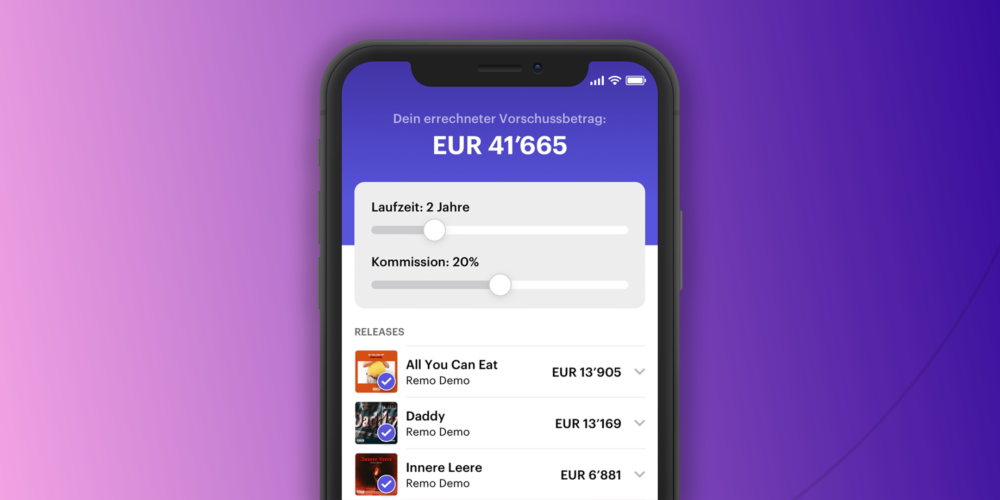
In your advance payment offer, you can define the following three points yourself:

  • Which releases are taken into account
  • The duration: How long the releases will be tied to iGroove
  • The deal: This is what defines the percentage of the earnings that will go to iGroove during the duration of collaboration

When you change the parameters, the advance payment offer will adjust automatically.

On the very top you will see your advance payment offer. Below that, you can take a look at how much you are projected to make off the release once you have recouped the advance payment. Additionally, the share that goes to iGroove is transparently displayed. At the bottom, you can view the projected earnings from the release. If you set the duration to two years, the amount listed here is the same as the one in the projection that you can download as a PDF.

No paperwork

Once you have found and accepted the ideal offer for you, a contract will be drawn up for you to sign digitally (legally binding). If you are already an iGroove client, you will receive the money in your account within just a few days. If you’re not a client yet, you will first need to transfer the releases listed in the advance payment offer to iGroove, and shortly after that, the money will be transferred.

Will I receive any income before I’ve recouped?

No, the earnings of the releases included in the advance payment will go to iGroove in full until the amount of the advance is in. Once the advance is recouped, you will receive the percentage of the earnings that is defined in the deal.

Why is the advance payment offer not higher than my previous earnings?

iGroove does not give out speculative advances. The offer is based on the previous numbers, which minimizes the risk both for iGroove as well as for the artist.

Best-deal guarantee

If you receive a better advance payment offer within 60 days, you can simply terminate the contract.

All additional information and answers to the most frequently asked questions can be found here.

How do I get the blue checkmark on TikTok?

What you'll learn in this post:
  • You can't apply for the blue checkmark on TikTok yourself
  • Which are the official and unofficial criteria of TikTok
  • Why only intensive users have a chance

Just like virtually every other platform, TikTok has verification that confirms it is the official channel. The more TikTok gains importance for musicians, the more this raises the desire for the blue checkmark. We show you the criteria that must be met for this.

As with most platforms, the blue hook is primarily awarded to companies and public figures, i.e. celebrities. However, at TikTok, at least so far, it is not possible to apply for it. So you have to first land on the TikTok team’s radar to be verified.

The criteria

TikTok requires:

  • That the account is authentic and unique
  • You are active on a regular basis
  • You follow the Community Guidelines and Terms of Service
  • You have a Pro-Account. You can change this yourself under Settings -> Manage Account.

A certain number of followers is not officially required, but normally accounts with many followers are preferred.

Besides the official there are also some unofficial criteria:

  • Daily follower growth of 500-2,000 followers
  • Steady growth in watch time and views
  • That established media regularly report about you
  • Content that goes viral
  • If you are verified on Instagram, Facebook or Twitter, your chances of getting the blue tick on TikTok increase.

Before you can hope to be verified, you first have to use TikTok intensively and continuously increase your reach. Moreover, one should take care of the verification with other portals first.

If you meet all the criteria, you can try to contact TikTok. To do so, click on “Report problem” in the settings and then select ” Pro account”. Now you have to explain why you think you deserve the hook. Chances increase if there are already fake profiles pretending to be you.